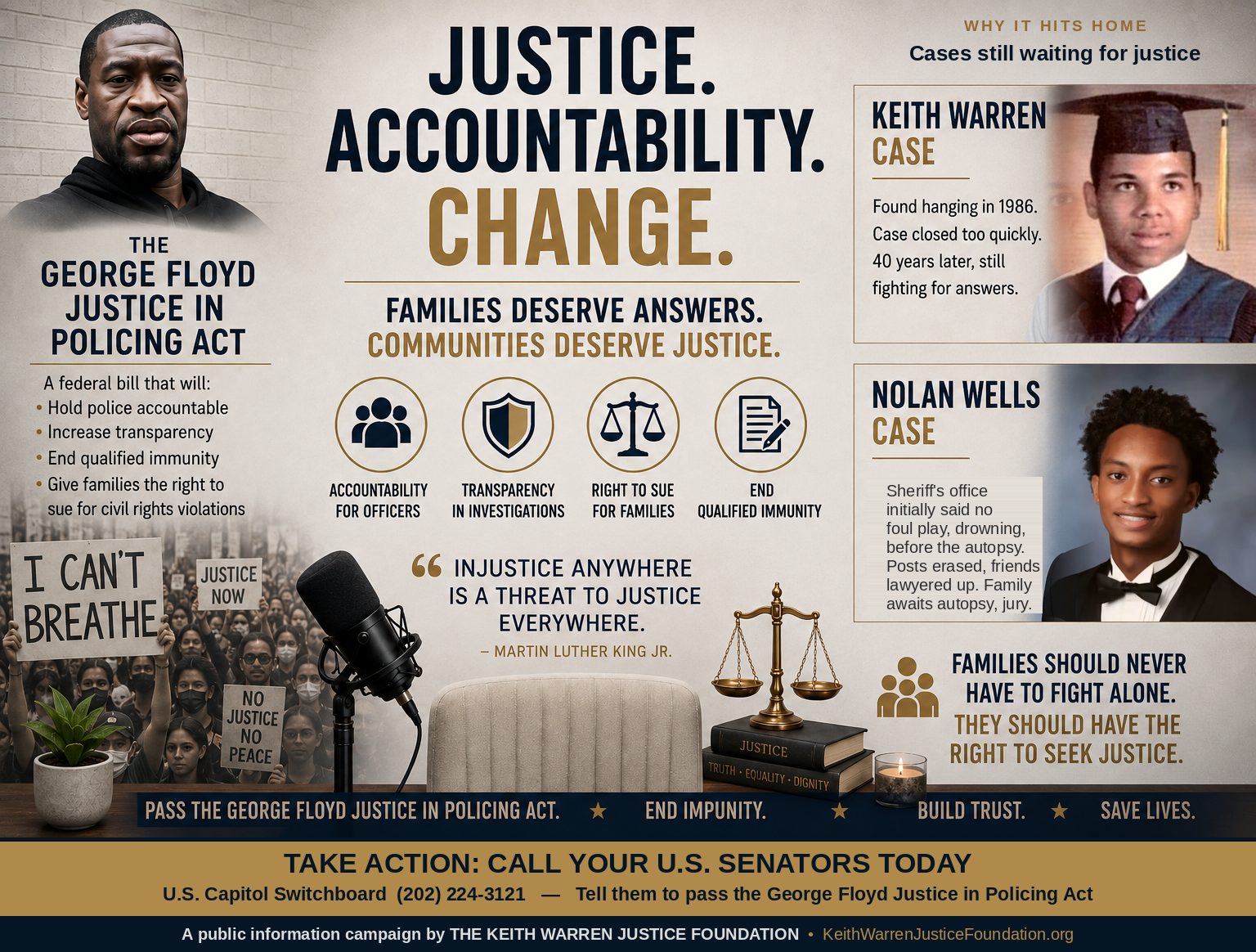
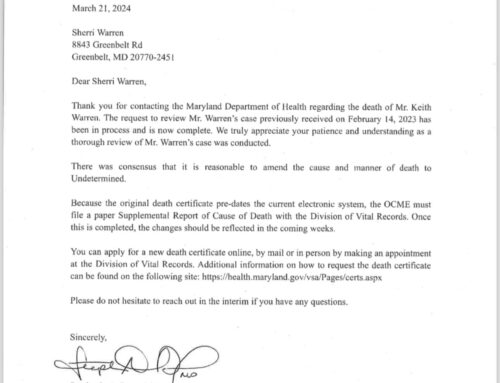
Forty years ago, my brother was nineteen years old when he was found hanging from a tree in Montgomery County, Maryland. His case was closed almost as fast as it was opened — no real investigation, no real answers, just a quiet decision that it wasn’t worth looking into. I believe my brother was denied equal protection under the law. The investigation into his death wasn’t given the same seriousness it would have gotten for a different victim, and I believe that itself is a civil rights violation.
The law, explained: Equal protection comes from the 14th Amendment. It means law enforcement is supposed to treat every case with the same seriousness, no matter who the victim is. When a case gets closed in hours instead of investigated for weeks, that’s not just bad police work — for families like mine, it can be evidence of exactly that kind of unequal treatment. That’s part of why the George Floyd Justice in Policing Act matters. It won’t reopen my brother’s case by itself, but it builds the tools that expose patterns like this — a national registry of police misconduct, federal authority to investigate departments with a pattern of failing certain communities, and an end to qualified immunity, so officers and departments can actually be held accountable instead of hiding behind a legal shield.
Why it matters beyond my brothers case: My brother’s case is forty years old, but this isn’t just about the past. Right now, there are families across this country watching their loved ones’ cases get closed too fast, for the same reasons mine was. Every time we let that happen without accountability, we tell the next department it’s okay to do it again. This bill won’t undo what happened to my brother — but it can stop it from happening to somebody else’s brother, sister, or child. If you believe every family deserves the same investigation, the same seriousness, the same justice, call your senators and tell them to pass the George Floyd Justice in Policing Act.
The bill (first passed by the House in 2020 and again in 2021 under Rep. Karen Bass, and reintroduced in May 2025 by Rep. Glenn Ivey as H.R. 5361) has never been signed into law — it stalled in the Senate both times after bipartisan talks collapsed in 2021, and the 2025 version is still sitting in committee.
On the four bullets points of the bill:
1-2. hold police accountable” and “increase transparency” are well supported — the bill creates a national police misconduct registry, mandates body cameras and use-of-force reporting broken out by race/age/disability, gives DOJ subpoena power for pattern-and-practice investigations, and lowers the criminal standard from “willful” to “reckless disregard” for civil rights violations.
3. End qualified immunity” is directionally accurate but slightly overstated as written — the House-passed text eliminates qualified immunity as a defense specifically for state and local law enforcement officers in civil suits; it doesn’t touch qualified immunity for other government employees (social workers, prison guards, etc.) and doesn’t create an equivalent remedy against federal officers, who are governed by separate (and more restrictive) Bivens doctrine. So it’s an end to qualified immunity for police specifically, not a blanket end to the doctrine.
4. “Give families the right to sue for civil rights violations” is more of an activist paraphrase than a literal new right — families already have the right to sue under 42 U.S.C. § 1983; what the bill actually does is remove the qualified immunity shield that currently blocks most of those suits from succeeding, which functionally makes that right meaningful rather than creating it from scratch.